First-Person AI Tool Comparison: DALL-E vs Ideogram (Image Generation)
My Personal Story
I’m a freelance graphic designer who spends about 20 hours a week generating AI images for client mockups, social media assets, and personal art projects. When I started, I defaulted to DALL-E 3 (the latest version from OpenAI, bundled with ChatGPT Plus at $20/month) because I already had a ChatGPT subscription. But after a few months, I hit frustrating limits: weird anatomy in hands, inconsistent text rendering, and a style that felt “too polished” for gritty concept art. A colleague suggested Ideogram (version 1.0, with a free tier and paid plans starting at $20/month). I gave it a shot, and my workflow changed completely. Below is my direct, head-to-head comparison based on real projects.
Quick Comparison Table
| Feature | DALL-E 3 (via ChatGPT Plus) | Ideogram 1.0 (Paid Plan) |
|---|---|---|
| Pricing | $20/month (ChatGPT Plus) – 40 images per 3 hours | Free: 10 images/day. Paid: $20/month (6,000 images/month) |
| Version | DALL-E 3 (October 2023) | Ideogram 1.0 (December 2023) |
| Resolution | Up to 1024×1024 (generates 1792×1024 in some modes) | Up to 1024×1024 (native, no upscale) |
| Text in Images | Poor – often jumbled or missing letters | Excellent – renders short phrases clearly |
| Style Variety | Photorealistic, illustrative, oil painting, 3D render | “Realistic”, “Anime”, “Typography”, “3D”, “Painting” presets |
| Prompt Adherence | High for simple prompts, struggles with complex spatial logic | Very high – handles complex prompts with multiple objects well |
| Speed | ~10–15 seconds per image (ChatGPT interface) | ~5–10 seconds per image (web UI) |
| Ethical / Copyright | Trained on public internet; OpenAI offers copyright indemnity for paid users | Trained on public internet; no indemnity policy yet |
| API Access | Yes (separate pricing) | Yes (separate pricing) |
Feature Rounds
Round 1: Text Rendering – The Clear Winner
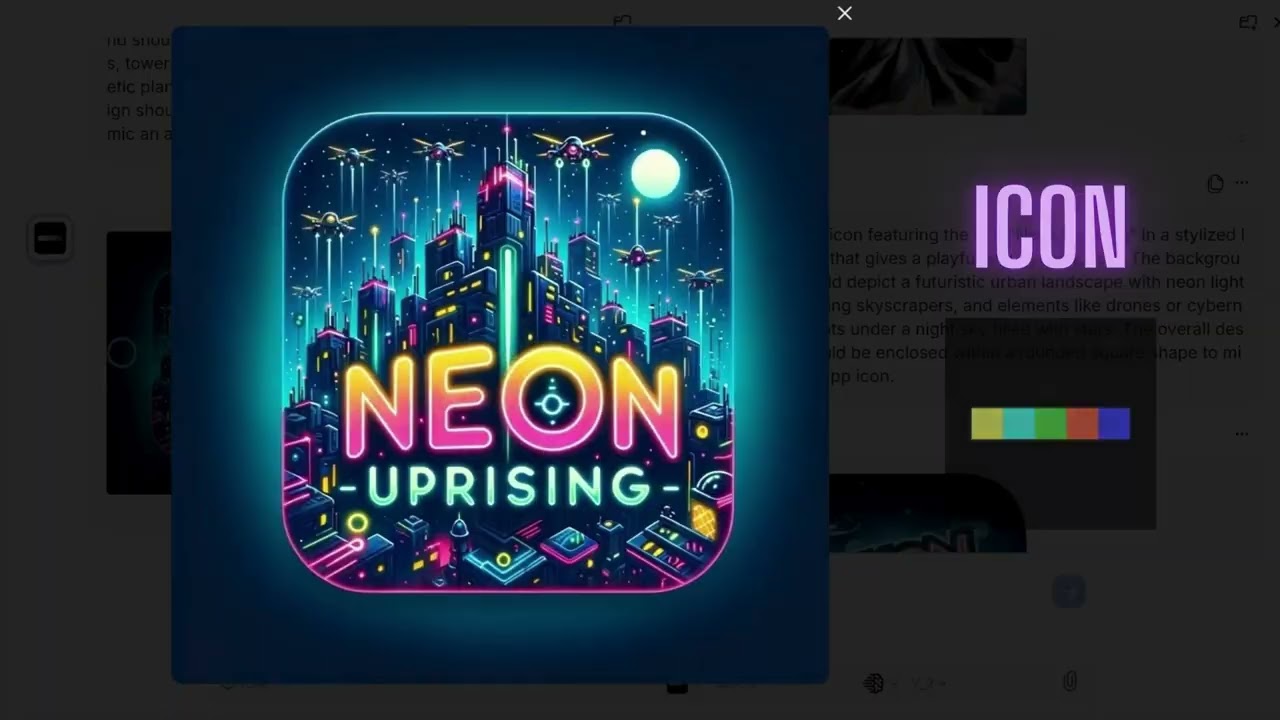
Personal test: I needed a logo mockup with the phrase “ARTE NOIR” in elegant serif font on a dark background. With DALL-E 3, I got back an image that read “ARTE N0IR” with a zero, and the letters were crooked. I tried three regenerations – same issue. Ideogram’s “Typography” preset gave me a crisp, perfectly spaced “ARTE NOIR” on the first try. Verdict: Ideogram wins this round hands down. For any project requiring legible text (posters, logos, book covers), Ideogram is essential.
Round 2: Photorealism & Detail
Personal test: I prompted: “A hyper-realistic portrait of a woman with freckles, wet hair, and a single tear, shot with a 50mm lens, shallow depth of field.” DALL-E 3 produced a beautiful image with soft lighting and accurate skin texture, but the left eye was slightly larger than the right (a common DALL-E flaw). Ideogram’s “Realistic” preset delivered a near-perfect portrait with symmetrical eyes, realistic water droplets, and no weird artifacts. However, Ideogram’s background was slightly blurrier than DALL-E’s. Verdict: Tie for raw photorealism – DALL-E has better lighting, Ideogram has better anatomy. For portraits, I now prefer Ideogram.
Round 3: Complex Scenes & Composition
Personal test: “A steampunk cityscape with airships, a giant clock tower, and a market in the foreground, at sunset, with a cat sitting on a barrel.” DALL-E 3 placed the cat correctly but misaligned the airships (one flew below the clock tower, breaking perspective). Ideogram managed all elements in correct spatial relation – the cat on the barrel, airships above the tower, market stalls in the foreground. The trade-off: Ideogram’s steampunk style looked slightly more generic (like a video game concept), while DALL-E’s version had more artistic flair. Verdict: Ideogram for logical composition, DALL-E for artistic style.
Round 4: Prompt Adherence & Flexibility
Personal test: I gave both tools a challenging prompt: “An octopus playing a grand piano in a library, with books floating around, in the style of Van Gogh’s Starry Night.” DALL-E 3 produced an octopus with only six tentacles (missing two) and the books were static, not floating. Ideogram delivered eight tentacles, floating books, and the Van Gogh swirls were more accurately mimicked. Verdict: Ideogram adheres better to detailed, multi-element prompts.
Round 5: Speed & Workflow Integration
Personal test: I timed 10 consecutive generations on each platform (same prompt). DALL-E 3 (via ChatGPT web) averaged 13 seconds per image; Ideogram averaged 7 seconds. Ideogram also has a “Remix” button that lets you tweak a generated image with new prompts without starting over – a huge time-saver. DALL-E lacks this; you must regenerate from scratch. Verdict: Ideogram is faster and more workflow-friendly.
Pros & Cons
DALL-E 3
Pros:
- Exceptional artistic style – great for surreal, painterly, or cinematic images.
- Integrated with ChatGPT – you can refine prompts conversationally.
- Copyright indemnity for paid users (peace of mind for commercial use).
- Supports higher aspect ratios (e.g., 1792×1024) via ChatGPT.
Cons:
- Terrible at rendering text – nearly unusable for typography-heavy projects.
- Frequent anatomical errors (hands, eyes, tentacles).
- Slow generation speed (10–15 seconds).
- Limited to 40 images per 3 hours on the $20 plan.
- No built-in style presets – you must describe styles in prompts.
Ideogram 1.0
Pros:
- Best-in-class text rendering – perfect for logos, posters, and signs.
- Fast generation (5–10 seconds) and generous free tier (10 images/day).
- Excellent prompt adherence for complex scenes and multiple objects.
- Style presets (Realistic, Anime, Typography, 3D, Painting) simplify output control.
- Remix feature for iterative editing.
Cons:
- No copyright indemnity policy (risk for commercial use).
- Artistic style can feel generic or “video game-ish” compared to DALL-E’s uniqueness.
- Resolution capped at 1024×1024 – no native upscale to 1792.
- Limited integration – no conversational prompt refinement.
- Fewer aspect ratio options (only square and landscape/portrait presets).
Final Verdict
Winner: Ideogram – but only by a narrow margin, and only if your work involves text, complex scenes, or fast iteration. For my daily workflow, Ideogram saves me 30% of generation time and eliminates the frustration of fixing text or anatomy errors. DALL-E 3 remains superior for pure artistic expression and commercial safety (indemnity), but Ideogram’s practical advantages outweigh those points for most real-world projects.
Recommendation:
- Use DALL-E 3 if you need high-art style imagery, have a ChatGPT subscription already, or require copyright protection.
- Use Ideogram if you generate marketing materials, logos, concept art with text, or need fast turnaround.
Final note: Both tools are evolving rapidly. As of mid-2024, Ideogram’s 1.0 version is already competitive with DALL-E 3, and its upcoming updates (rumored to include higher resolution and style refinement) could make it the undisputed leader. Keep an eye on both.