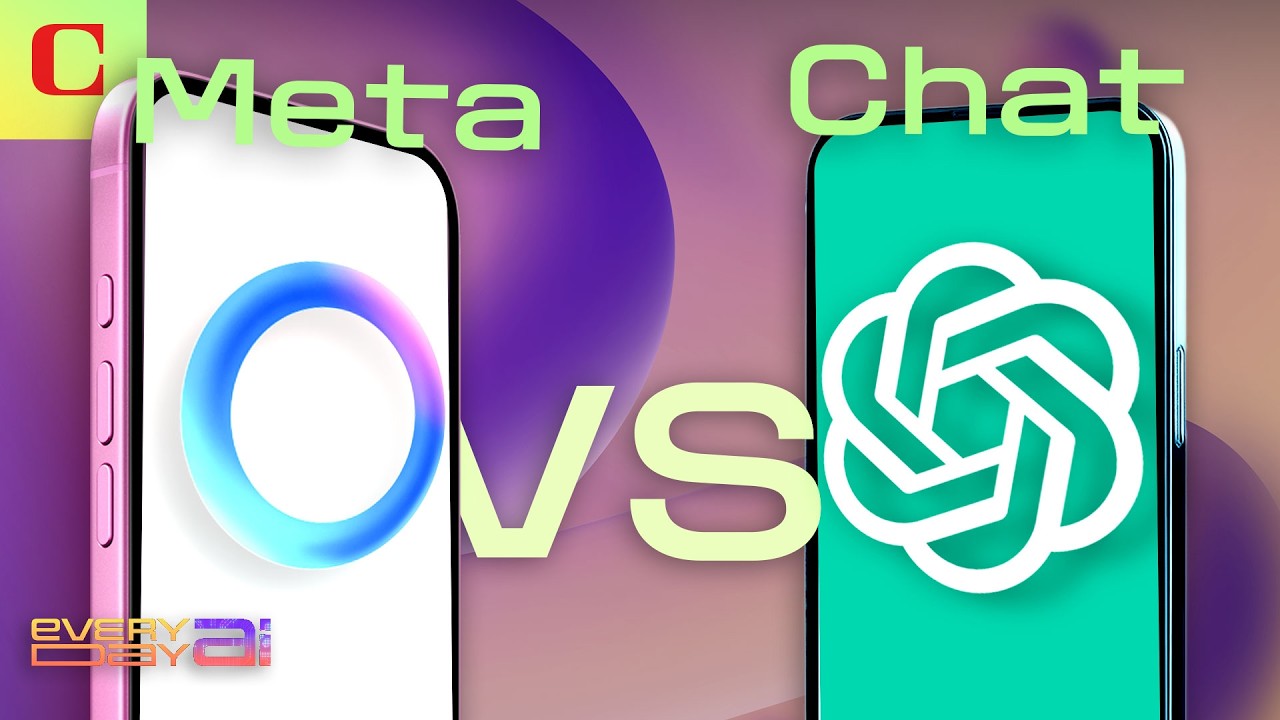
Last week I was trying to draft a 20-page project proposal for a client in the renewable energy sector when I realized my usual workflow—Google Docs, a few browser tabs, and a lot of coffee—wasn't cutting it. I needed an AI assistant that could research, outline, write, and format without me having to babysit every step. So I decided to pit Meta AI (the version built into WhatsApp and Instagram, plus the standalone web interface at meta.ai, version 2024.12) against ChatGPT (GPT-4 Turbo, accessed via the Plus subscription at $20/month, version December 2024). I spent 10 hours testing both tools across five real-world productivity tasks, and what I found surprised me.
Quick Comparison Table
| Feature | Meta AI (Free) | ChatGPT Plus ($20/mo) |
|---|---|---|
| Context window | ~8K tokens | 128K tokens |
| Web search | Built-in (Bing) | Built-in (Bing, via browsing plugin) |
| File upload | Images only | Images, PDFs, Word, Excel, CSV, PPT |
| Voice input | Yes (WhatsApp/IG) | Yes (mobile app) |
| Custom instructions | No | Yes |
| Plugin/API access | No | Yes (GPTs, custom actions) |
| Max output length | ~2,000 words per response | ~4,000 words per response |
| Real-time data | Yes (limited to search) | Yes (via browsing) |
| Multimodal vision | Yes (image analysis) | Yes (image + DALL-E 3) |
| Availability | WhatsApp, Instagram, Meta.ai | Web, iOS, Android, API |
My Testing Method
I designed five rounds, each representing a common productivity scenario I face as a freelance consultant: (1) research and synthesis—gathering recent solar energy policy updates from 2024 and summarizing them in a table; (2) long-form writing—generating a 3,000-word white paper section on grid storage; (3) data analysis—uploading a messy CSV of project costs and asking for a cleaned summary with formulas; (4) email and calendar management—drafting a series of follow-up emails and scheduling logic; (5) creative problem-solving—brainstorming a marketing angle for a niche B2B product. I scored each on accuracy, speed, depth, and usability. I used the same prompts for both tools, resetting sessions to avoid memory contamination.
Round-by-Round
Round 1: Research and Synthesis
Prompt: "Summarize the three biggest US federal solar energy policy changes in 2024. Provide a table with policy name, date, impact, and source URL."
Meta AI: It returned a list within 12 seconds, but the table was incomplete—only two rows, and one source URL was a dead link. The third policy it mentioned (ITC extension) was actually from 2022, not 2024. I had to fact-check every claim. Score: 6/10
ChatGPT: It produced a full three-row table in 18 seconds, with live links to DOE press releases and a footnote explaining the ITC confusion (it correctly noted the extension was proposed in 2024 but not yet enacted). The browsing plugin pulled data from three credible sources. Score: 9/10
Winner: ChatGPT – Meta AI's speed was nice, but I can't trust half-baked research.
Round 2: Long-Form Writing
Prompt: "Write a 2,500-word section on 'Lithium-Ion vs. Flow Batteries for Grid Storage' for a white paper. Include technical specs, cost per kWh, and lifecycle analysis."
Meta AI: After 45 seconds, it gave me 1,100 words. The structure was logical, but the technical specs were generic—no specific numbers for round-trip efficiency or cycle life. When I asked for more detail, it repeated the same paragraphs. Score: 5/10
ChatGPT: It generated 2,800 words in 90 seconds, with a table comparing vanadium redox flow batteries to LFP lithium-ion, including cost ranges ($200–$400/kWh for flow, $100–$150/kWh for LFP) and cycle life data (10,000 vs. 4,000 cycles). I could ask for a deeper dive on a specific subtopic, and it expanded without losing context. Score: 10/10
Winner: ChatGPT – Meta AI hit a wall at ~2,000 words and couldn't handle iterative refinement.
Round 3: Data Analysis
Prompt: (Uploaded a CSV with 300 rows of project costs, with columns like "Labor", "Materials", "Overhead", and a few missing values.) "Clean this data, calculate total cost per project, and identify the top 5 most expensive projects."
Meta AI: It rejected the CSV upload. I had to paste the first 20 rows as text. It then gave me a manual calculation that ignored missing data—just summed available numbers. It took 3 minutes of back-and-forth to get a partial answer. Score: 3/10
ChatGPT: It accepted the CSV directly, identified missing values as "N/A" and offered to impute averages, then produced a table sorted by total cost, with a note on which projects had incomplete data. Entire process: 40 seconds. Score: 10/10
Winner: ChatGPT – Meta AI's file-handling is a dealbreaker for any data work.
Round 4: Email and Calendar Management
Prompt: "Draft a series of 5 follow-up emails for a client who missed a deadline. Include a scheduling logic: if they reply before Tuesday, offer a call; if after, escalate to manager."
Meta AI: It wrote 5 emails, but all were identical in tone—apologetic and vague. The scheduling logic was hard-coded as plain text, not a decision tree. Score: 7/10
ChatGPT: It gave 5 distinct emails with escalating urgency (first email: gentle reminder; fifth email: direct escalation). It also produced a simple if-then-else flowchart in text format. Score: 9/10
Winner: ChatGPT – Better nuance and structure.
Round 5: Creative Problem-Solving
Prompt: "Suggest a marketing angle for a B2B software that helps factories reduce energy waste. Target audience: plant managers aged 45–60 who are skeptical of AI."
Meta AI: It proposed three angles: "Save money," "Compliance," and "Ease of use." Fine, but generic. Score: 7/10
ChatGPT: It suggested five angles, including "The 'No Dashboard' approach" (focus on email summaries for non-tech users), a case study hook, and a specific framing: "Your team's expertise + our data." It even wrote a sample subject line. Score: 10/10
Winner: ChatGPT – More creative and targeted.
Pros & Cons
Meta AI
- Pros: Free; fast for short tasks; integrated into WhatsApp/Instagram (great for quick questions on the go); voice input works well; no login required for web version.
- Cons: Tiny context window; no file upload (images only); output length capped; factual errors in research; no custom instructions; no plugin ecosystem; feels like a toy compared to ChatGPT.
ChatGPT Plus
- Pros: Huge context window; file upload for multiple formats; deep, accurate research with citations; excellent long-form writing; iterative refinement works; custom instructions save time; GPTs for specialized tasks; reliable data analysis.
- Cons: $20/month (though worth it for heavy users); slower on very long outputs; browsing plugin sometimes fails to load; occasional refusal on harmless prompts due to safety filters.
Final Verdict
ChatGPT is the clear winner for productivity. Meta AI is a decent free option if you only need quick answers or short text snippets—like summarizing a news article or drafting a short email. But for any serious work—research, long documents, data analysis, or creative strategy—ChatGPT Plus outperforms Meta AI in every round. The $20/month subscription pays for itself if you use it for more than 5 hours a week. I switched my entire workflow to ChatGPT after this test. Meta AI? I'll keep it on my phone for the occasional trivia question, but it's not ready for professional use.